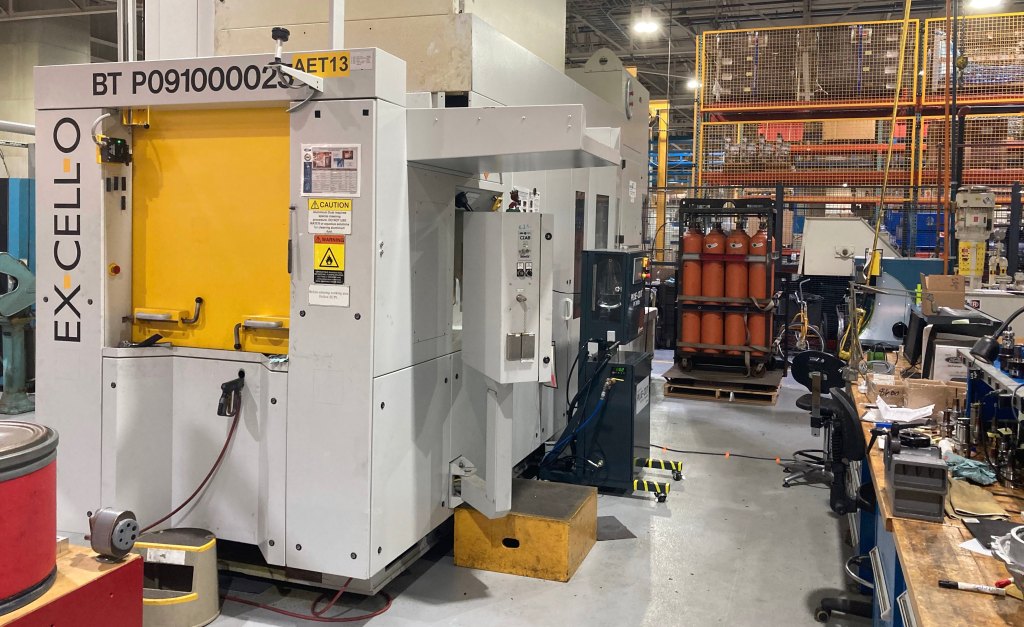
Welcome. This issue’s cover photo shows a gearbox cover, aka differential cover, set up for a drilling test. As with the stator on the Pulsebeat 06 cover, there are two of these in your F-150 Lightning, one in each drive unit. This part is actually an assembly, since it consists of an exquisite steel ring gear mounted in a handsome aluminum diecasting, like a jewel in a setting.
I worked on this part for the last fifteen months of my engineering career. In the spring of 2021, I was a salaried employee of the Ford Motor Empire, laboring as a technical expert in the Powertrain Manufacturing Engineering department. I was also coasting at roughly a 30° angle toward retirement at the end of the year, and looking forward to a quiet life of reading, music, and poetry. We were starting to manufacture the Lightning electric pickup truck then, and the gearbox cover was an early problem child due to a design change and floorspace issue. New holes were added after space had been allocated in the plant and the initial machines had been installed, and there was not enough room left over for the additional machines required to drill them. It was the classic “ten pounds of shit in a five-pound bag” problem, a faint echo from Highland Park and the Model T. They needed to figure out how to drill the new holes much faster, with fewer machines, to make things fit. It was an exceedingly rare instance in which a drilling expert might briefly be viewed as a valued contributor, not just a necessary evil. I was one of several people expected to come up with potential solutions to evaluate.
Some years earlier, I’d quit my job at General Motors and spent the next seven years wandering the industrial world, surviving on odd jobs and contract work, until I hired on at Ford. One thing I’d worked on was the high-pressure gas lubrication system featured on the Pulsebeat 04 cover. I’d run tests with early versions of this system on different kinds of machines, under various commercial arrangements but generally in remote and desolate factory towns. Being observant, I’d noticed that it was really good for drilling holes fast, and sitting at Ford all those years later, it eventually occurred to me that we could drill the troublesome new holes with the gas, no problem, and that we would in fact have time left over.
I brought this up at one of the meetings and said I would do some tests at a local shop that had a system. I didn’t think there was any chance they would put something that experimental into high volume production, but I had not considered that there were no other boats in the water, and no sails on the horizon. The test results were promising, and I was directed to set a machine up for gas lube drilling and develop the tooling and process for production. At that point I realized I could not retire before things were working to some level and my younger colleagues were up to speed. In the parlance of the business, that would be tossing a turd on the table, rotating 180°, and walking away. So I said I would stay on past the end of the year to see it through.

I was depressed by this development, and decided I would do something poetical at the same time, to at least get the ball rolling on my literary life while I was finishing this job. I had been thinking about starting an online poetry journal for several years, and was finally motivated to work on it, and launched Pulsebeat in September 2021. If I hadn’t gotten myself embroiled in the gearbox cover drilling problem, I would not have launched it then, and may never have launched it, given my tendency to get sidetracked. I’m glad I did. The reading period for Pulsebeat 09, which will be posted in September 2024, begins June 1. Until September, enjoy the wonderful poems in this issue.
 Pulsebeat Poetry Journal