Welcome. This issue’s cover shows left- and right-hand ear loop cutters for an automated surgical mask making system. These cutters were designed and fabricated by engineers and machinists at Future Tool in Romulus, MI, a top-of-the-line machine shop.
I was a critical infrastructure worker at Ford during the pandemic. When the lockdown hit, I was a technical expert reporting to the chief engineer for machining systems and assigned to special projects. I was focused at the time on a tappet bore machining problem on the 7.3l Godzilla V8 manufactured at Windsor Engine. Ford closed all North American and European plants on March 19, 2020. The plants did not reopen until May 18.
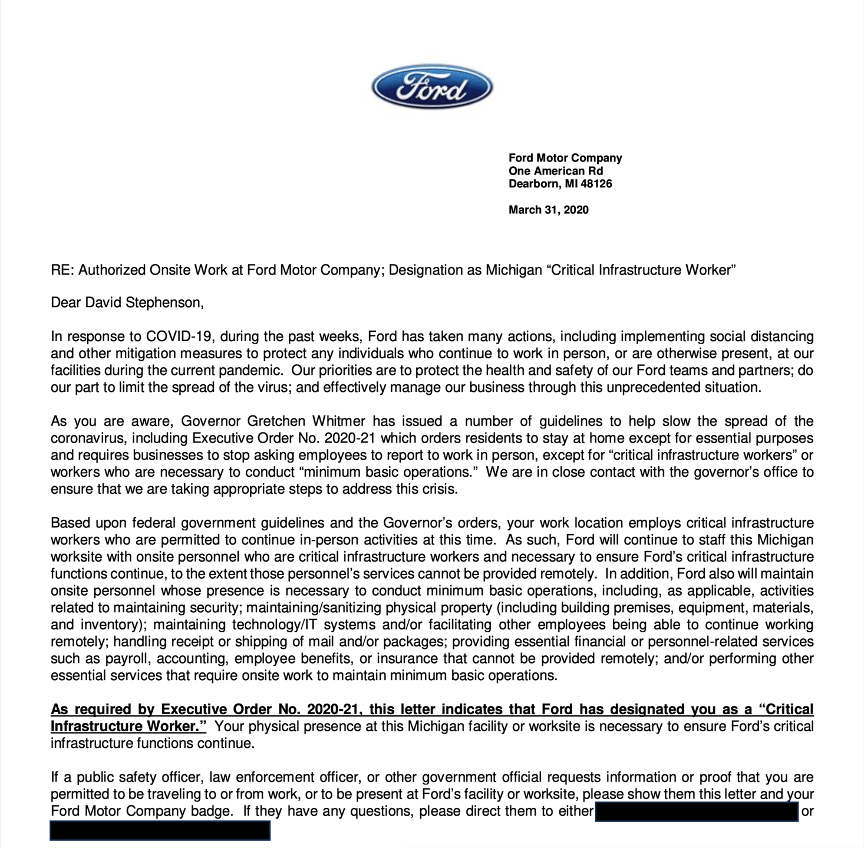
General Motors and Ford were ordered to make ventilators under the Defense Production Act on March 27. Ford also began making cloth masks, since about 400,000 a week would be needed in North America when the plants reopened and the workforce returned, and they were in short supply. The ventilator and mask efforts and related activities were combined under Project Apollo, which I was assigned to work on. On March 31 I received a form letter informing me that I had been designated as a critical infrastructure worker, part of which I reproduce below as a curiosity.
Everyone assigned to Project Apollo was eager to contribute. In the first few days there was a lot of unfocused activity since no overall plan had been formulated and communicated. I went to a couple of meetings on ventilator production, and made no positive contribution other than leaving early. The challenges in manufacturing ventilators primarily concerned assembly, since the units were designed for craft production and didn’t go together easily.
I was more useful in mask making. All automatic transmission plants have clean rooms where a component called a valve body is assembled. And empty clean room at Van Dyke Transmission was soon equipped with automatic mask making systems. (I never heard who arranged all this, but they had serious foresight and pull.) These systems were Chinese machines with different safety features than we were used to; in particular, the big red button was not an emergency stop, but only paused the cycle for a few seconds. One of our engineers learned this the hard way when he hit the button, stuck his hand in the station, and suffered a laceration when it cycled. The room was kept at about 25 deg C and well over 50 percent humidity to keep the cloth pliable, and you had to wear a full plastic suit when you were in there, so you sweated like you were shoveling coal. There is a video of the operation at this link.
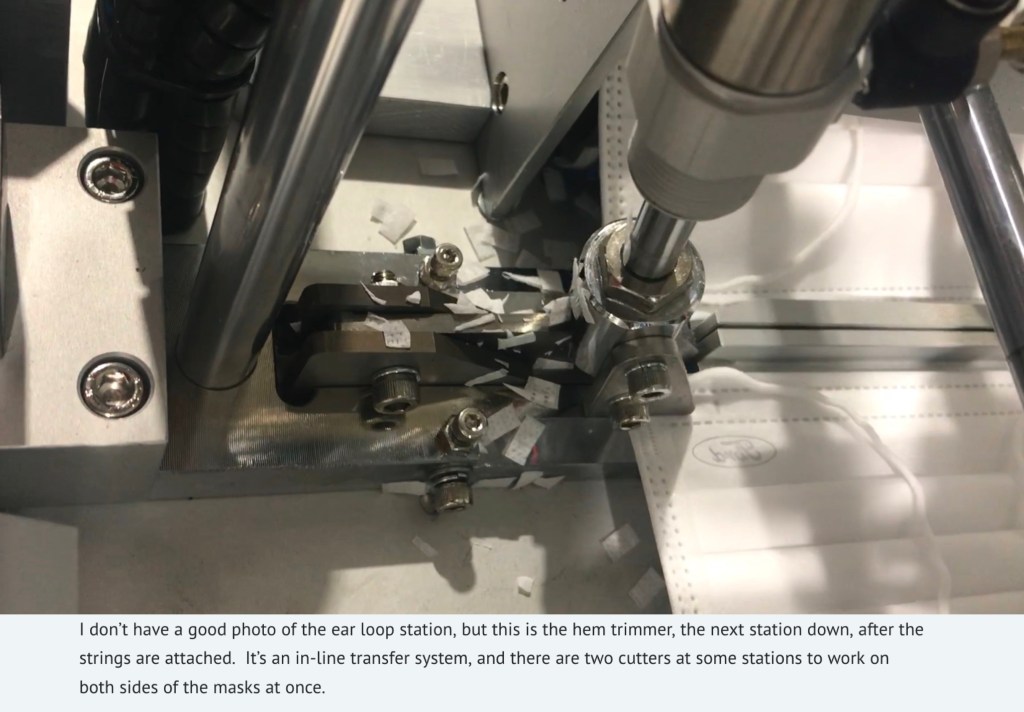
There were problems early on with the ear loop cutters, which cut the strings that loop around your ears. The cutters would get jammed up with string fibers and have to be cleaned out frequently. Since I was a tooling expert and the component was called a cutter, I was asked to help fix the problem. The first thing I noticed was that the cutters were essentially mechanized scissors, reflecting a tailor’s limited conceptual universe. To cut flexible fibers cleanly you want a rotating blade spinning at a high speed, so that the blade passes through the fibers before they have time to bend out of the way. This is why your lawnmower’s blade spins at 3000 rpm. But I was told not to invent anything, just to fix what they had. I worked with the team at Future Tool, and they designed a sealed unit with much less propensity to jam. I had minimal input on a couple of details in the design, and think they were just humoring me because I was the Ford contact.
I took prototypes to the plant, and also took blades to a shop for coating, so I was useful as a delivery driver. In the early days the driving was actually quite harrowing, since the streets were deserted and people were driving at high speeds and running stop signs, assuming there was no one else around. But that subsided within a couple of weeks. When the plants reopened I went back to my regular routine of production support and development tests for future programs. It was a lot like before, except for all the masks and temperature checks, and all the people still at home.
The reading period for Pulsebeat 15, which will be posted in September, begins June 1. Until September, enjoy the wonderful poems in this issue.

